Same shares, different months: why most SACCO dividends are not fair
A flat dividend per share pays a member who joined in October the same as one who has been there since January. Time-weighting fixes that, and it is only hard in a spreadsheet.
TECH247 LIMITED9 Nov 20265 min read
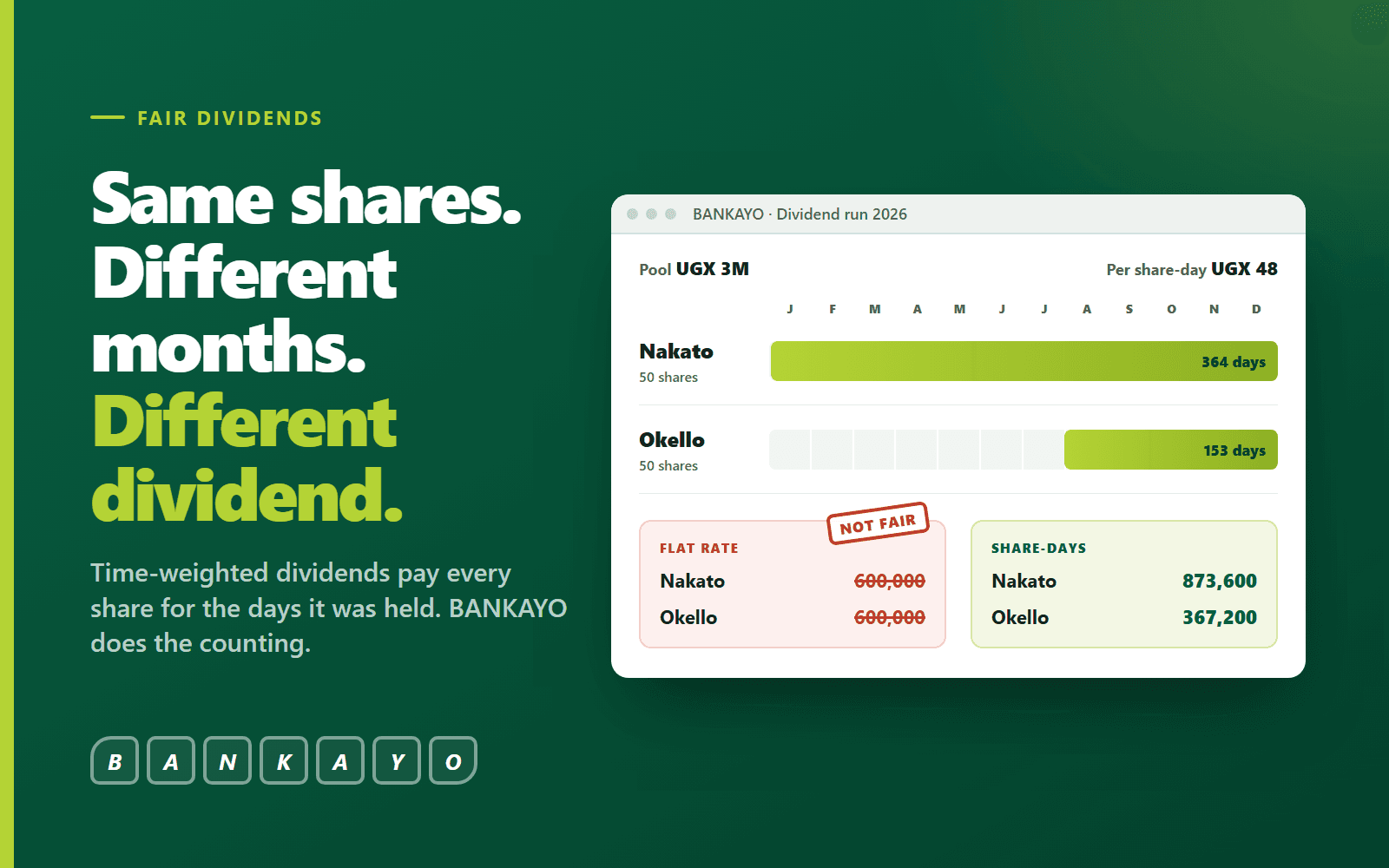
A dividend is a reward for capital that worked for the society. Most SACCOs pay it as if every shilling worked for the whole year.
It is AGM season, and in a lot of boardrooms the dividend sheet has one formula in it: shares at year end, multiplied by a rate. It is simple, it adds up, and it quietly moves money from your longest-standing members to the ones who arrived last.
The flat rate is a closing-balance dividend
When the treasurer multiplies each member's closing share balance by a rate, the society is using what accountants call the closing-balance method. It looks at one date only, 31 December, and ignores everything that happened before it.
That means:
- A member who bought 50 shares on 2 January and a member who bought 50 shares on 1 August get the same dividend, even though the first member's money funded loans for seven more months.
- A member who tops up in December to "catch" the dividend gets a full year's return on money that worked for a few weeks.
- A member who builds shares slowly, a little each month, is treated as if every share had been there since January.
The alternative is time-weighting: pay each share for the days it was actually held. Bylaws often already say the dividend follows the time the capital was in. Most dividend sheets do not. (We covered why share capital needs its own rules in Shares vs savings.)
Why societies fall back to the flat rate
Nobody chooses the unfair method on purpose. They choose the one Excel can do before the AGM.
To time-weight in a spreadsheet you need a row for every share purchase, not one row per member. You need the exact date of each purchase, a days-held column, a share-days column, a total, and a rate worked out from that total. Then you need to handle the members who bought in three instalments, the one who transferred shares to a relative in June, and the one whose purchase was keyed with the wrong date in March.
Every one of those is a chance for a broken formula, and the treasurer usually finds out in the WhatsApp group. So the society agrees, often without saying it out loud, to "keep it simple". We wrote about this pattern in The spreadsheet ceiling: the sheet works until the rules get real, and then people start bending the rules to fit the sheet.
A worked example
A small investment club has five members and 250 shares at year end. The AGM approves a dividend pool of UGX 3,000,000.
The flat rate. 3,000,000 ÷ 250 shares = UGX 12,000 per share.
Time-weighted. Count the days each share was held up to 31 December, including the day it was bought. These dates are in 2026, which is not a leap year, so a share bought on 2 January has 364 days. Multiply shares by days to get share-days, add them up, and divide the pool by the total.
| Member | Shares bought | Days held | Share-days | Flat rate (UGX) | Time-weighted (UGX) |
|---|---|---|---|---|---|
| Nakato | 50 on 2 Jan | 364 | 18,200 | 600,000 | 873,600 |
| Achieng | 70 on 1 Apr | 275 | 19,250 | 840,000 | 924,000 |
| Namuli | 20 on 2 Jan, 50 on 1 Jul | 364, 184 | 16,480 | 840,000 | 791,040 |
| Okello | 50 on 1 Aug | 153 | 7,650 | 600,000 | 367,200 |
| Kato | 10 on 1 Oct | 92 | 920 | 120,000 | 44,160 |
| Total | 250 | 62,500 | 3,000,000 | 3,000,000 |
The total is 62,500 share-days, so each share-day earns 3,000,000 ÷ 62,500 = UGX 48. Nakato's dividend is 18,200 × 48 = 873,600.
Look at what the flat rate did:
- Nakato and Okello both hold 50 shares, so the flat rate pays them 600,000 each. Time-weighted, Nakato earns 873,600 and Okello earns 367,200. Under the flat rate, Nakato was short 273,600 and Okello was overpaid 232,800.
- Namuli and Achieng both finish the year on 70 shares. Achieng had all 70 from April. Namuli had 20 from January and topped up 50 in July. Time-weighting tells them apart; the flat rate cannot.
- Kato joined in October and would have collected 120,000 for three months of capital. Time-weighted, he gets 44,160.
Both columns add up to the same 3,000,000. Time-weighting does not cost the society anything. It only decides who gets the money, and it gives it to the members whose capital was there the longest.
Why days, not months
Some societies try to meet halfway by counting months. It is better than a flat rate, but it creates its own arguments. Does a share bought on 31 January count for January? Does one bought on 1 February lose a whole month? Two members who bought a day apart can end up a month apart.
Days remove the argument. The share was in the society's books from the day it was paid for, and it earns for exactly that many days.
How BANKAYO does it
In BANKAYO, every share purchase is a dated transaction on the member's share account. The register keeps the movements, not just a balance, so the information time-weighting needs is already there when the year ends.
When you run the dividend, BANKAYO:
- Takes the pool the AGM approved, and the period you set.
- Counts share-days for every approved purchase, including a top-up, from that purchase's own date. Days run from the purchase date up to the period end. The end date itself is not counted. The table above includes 31 December, so the period end for that run is 1 January 2027. Shares already held when the period opens count from the period start. If the product has a minimum active period, a purchase held for fewer days than that is left out.
- Divides the pool by the total share-days and applies that rate to each member. Amounts are rounded to the currency. With the period end on 1 January, this example is an exact UGX 48 a share-day, and the member amounts add back to 3,000,000. When the rate does not divide evenly, rounding can leave the payout slightly off the approved total.
- Lists each member's dividend, so the treasurer can take the allocation to the AGM. Members can see each purchase and its date in the Self Help app.
There is no row-per-purchase spreadsheet to build and no formula to copy down. A payout that has not been approved can be deleted and run again. Once it is approved, it is posted. Check the dates before you approve: an approved share purchase cannot have its date edited.
Fairness used to be the expensive option. It is not any more.
If your society still pays a flat rate because the time-weighted version was too hard to build, send us last year's dividend sheet. We will show you what it looks like with share-days, and how far each member's dividend moves.