The board pack: reports a SACCO actually runs
You already know the income statement and the balance sheet. The hard part is printing them from the same ledger as PAR, cash, and the share register — not rebuilding them in Excel the night before the meeting.
TECH247 LIMITED19 Sept 20264 min read
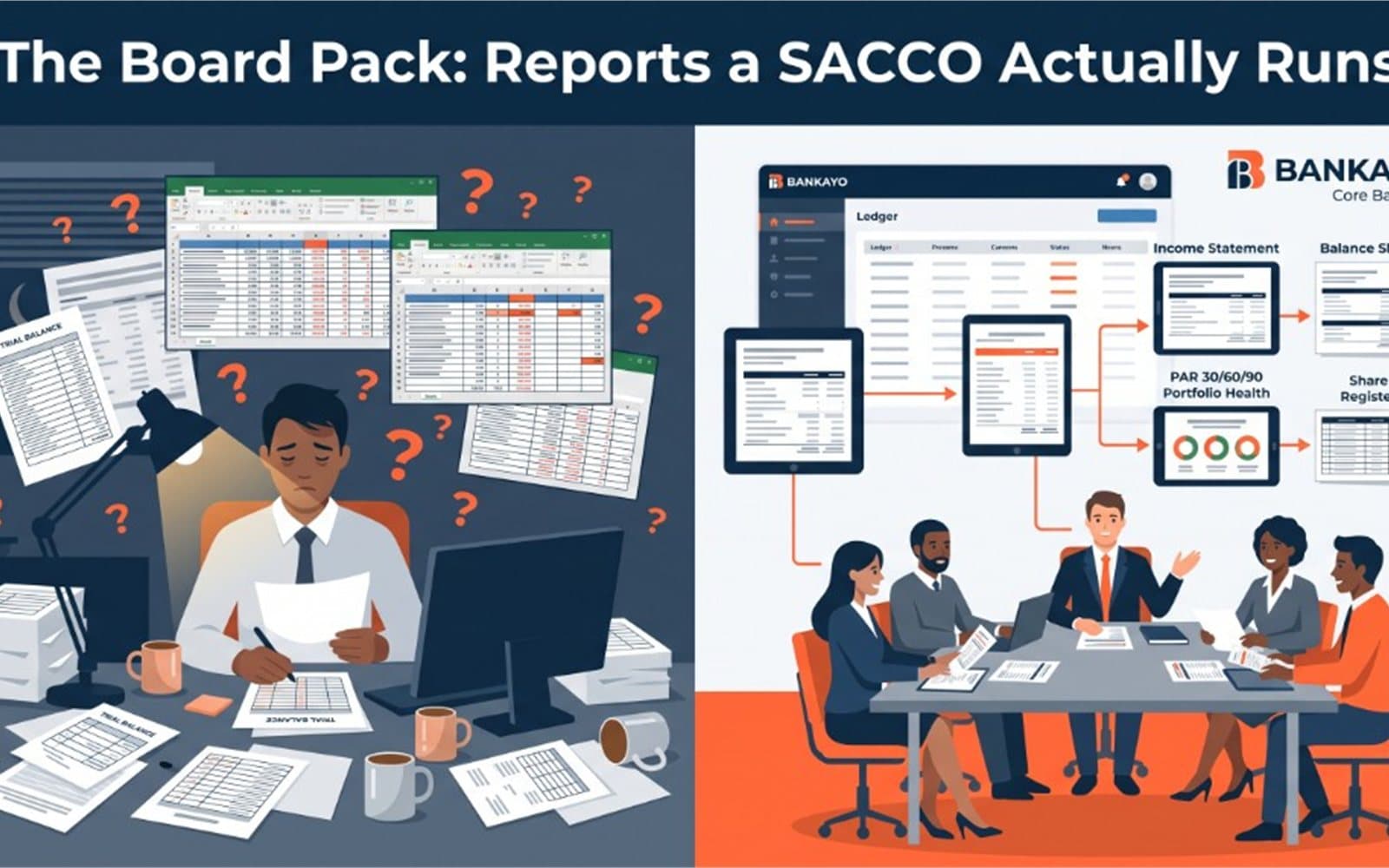
The Tuesday board pack is not a screenshot. It is a date, a set of numbers, and the ability to print the same pack next month and get the same story.
Most people who keep a SACCO’s books already know the two statements that close the meeting: the income statement (what we earned and spent in the period) and the balance sheet (what we hold and what we owe on a date). They are not exotic. They are ordinary. The struggle is generating them when the loan book, the savings book, and the share register live in three files and none of them posts through a general ledger.
This is a map of the packs people actually open — and why those two statements only become cheap to print once the core is doing the posting.
The two statements you already know
An income statement is a period. Interest income, fees, charges, personnel, the surplus the AGM will argue about. A balance sheet is a date. Cash and bank, the loan book, member savings (a liability), share capital (equity), payables.
If you have closed books by hand, you can draw both on a whiteboard. The work is not knowing the shape. The work is:
- Every product posting to the right GL account — a disbursement that never hits “loans outstanding” will never sit on the balance sheet.
- Shares treated as equity, savings as a liability. Mix them and the balance sheet needs a manual journal every closing. We wrote that in shares versus savings.
- A closed business date. Print the income statement for August after September’s interest has been posted and you are no longer talking about August. The night run is how the period actually ends.
Without that, the accountant already knows what the statements should look like. They rebuild them in Excel from extracts, till counts, and a trial balance that does not tie. The meeting gets a pack. The ledger does not recognise it.
A core does not invent a new kind of income statement. It lets you print the one you already understand from the same books credit and the teller already use.
The rest of the pack
The statements do not travel alone. The room also asks for the packs below. They have to agree with the income statement and the balance sheet, or someone will “adjust” a line and the two statements become a third workbook.
Board / GM. Portfolio outstanding, PAR 30, 60 and 90, liquidity, and the surplus that should match the income statement. One as-of date, one office or the whole institution. The operator workspace already shows PAR and days past due that way. The board pack is that fact, plus the two statements, on paper they can take into the room.
Credit. Aging buckets, listing by officer or product, expected versus collected, disbursements in the period. PAR is a bucket a loan falls into when a date arrives — not a feeling about the book. The loan listing’s outstanding should be the loan line on the balance sheet.
Cash and till. The cash on the balance sheet is the tills and the bank, after the day’s postings. A float that only exists in a mobile-money spreadsheet will not appear until someone journals it.
Members and shares. Individual statements (the passbook, without the passbook). The share register: who holds what. The dividend working: time-weighted if that is the bylaw. Share capital on the balance sheet is that register, totalled.
Regulator. The format they asked for — often the same income statement and balance sheet, their headings. We will not invent a form code. Same books, their columns. If the core cannot emit that shape, someone will copy-paste from the Excel rebuild. That is how two truths start.
What has to be true before you hit print
Reports do not create numbers. They read what was posted.
- A closed date. End-of-day (or the jobs that play that role) has finished for the as-of you print.
- One member, one set of identifiers. Duplicates become two lines on a statement and a fight at the AGM.
- Products that post to the right GL. A charge that never hits the account will never hit the income statement; a loan that never hits the asset account will never hit the balance sheet.
- Maker-checker on the things that move the pack. A silent override on a pledged-share loan will not match the listing credit thought they signed.
If those are missing, a prettier report writer will still lie. You will still know what an income statement is. You will still build it by hand.
What BANKAYO is for
Apache Fineract carries a general ledger, standard reports, and stretchy (custom) ones. BANKAYO stands that engine up, supports it, and fits products so the postings land where your chart of accounts already says they should.
Then the income statement and the balance sheet are a print — for the period or the date you choose — not a weekend project. We also fit the listings you already run and the return the supervisor asked for. We do not promise a complete government catalogue. We do not claim a percentage of reports “automated.”
If you already know the two statements and you still rebuild them the night before the board, send last month’s pack — even if it was typed. We will say what the ledger has to hold before those two pages can come out of the core instead of the workbook.